Showing posts with label summary. Show all posts

Wednesday, 18 March 2009

ECO 18th Balance of payment

Balance of payment:a record of money flows coming in and going out of a country.


WHAT IN BALANCE OF PAYMENT?


1.trade in goods


2.trade in services


3.net flow investment income


4.transfer of money


Trade deficit:money going out is more that money coming in


Tuesday, 17 March 2009

Eco 17th Macroeconomic and TAX

Macroeconomic equilibrium:


TAXes:

The money which government use to improve health,education,and sort of problems is tax

Category of Tax:

direct TAX:tax which get from the percentage of people`s income and company and cannot avoid.

As we know, people and salary monthly,but they must pay income tax at the same time.This is one way where government get the money from in order to something else to improve specific section.In China the start point is 1600 yuan(160pound),but as your income increase your income TAX will increase as well....income TAX is the one of the main TAX government used to get money from,it plays a important role in government.

Also,company should pay direct TAX as well,it is the percentage of your company profit.Big company pay thousands and thousands TAX to the government.

indirect TAX:a tax levied on the goods and services

another essential TAX is indirect TAX,which we can see it everywhere.Whenever we go shopping and buy something we may noticed that there is VAT(value added tax)a part of the indirect TAX in the end of receipt,in UK is has reduced to 15%.In some luxury goods,such as cars,clothes...etc..government will higher the TAX for controlling.As for cigarette,UK government has higher the TAX,the tax is even more that cost.Furthermore according to the elasticity if higher the TAX on cigarette ,consumer will pay more(inclasticity) the reason why government do that is because it cause negative externality(which affect third parties)it is harmful for our normal life

But it`s not easy to control people not to smoke by using TAX on cigarette,because it`s inelasic even the TAX is high and price is increase,people are likely to buy it as normal.


Eco 17th

1.I put comment on first-time`s blog(It`s about house price)


2.David`s economics(the bank of England on deflation)


Deflation:a sustained fall in the general price level


Bad deflation:fall in aggregate demand may result in a harmful consequence.Lower aggregate demand will cause business firms to cut back production.It may cause unemployment ...Also might influence a country`s economy growth...


Good deflation:a fall in price level arising from cut costs of production to stimulate cosumers expending,supply will shift to the right,therefore more and more producers may have satisfying profit from deflation.Moreover productivity likely to rise as well....so we know that the output is growing.Country`s international competitiveness increase gradually.


3.Economics teacher`s blog:


Monday, 16 March 2009

ECO 16th

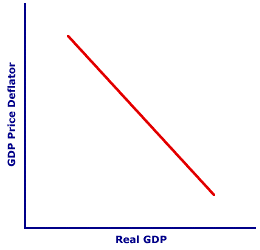
PPC(production possibility curve:show the maximum quantities of different combinations of output of two products
Opportunity cost:the next best alternative foregone
Elasticity:the extend to buyers and sellers respond to a market conditions
Unemployment:people are out of work but willing and able to work
Inflation:a sustained rise in the price level
Economic growth:an increase in real GDP,in the maximum output that the economy can produce
Exchange rate:the price of one currency in terms of another currency
fiscal policy:the taxation and government spending decisions of a government
monetary policy:decision on the interest rate the money sullpu and exchange rate
supply-side policy:policy to increase aggregate supply


AD:the total goods and service in period of time


AS :the total amount that producers in an economy willing and able to supply

Sunday, 8 March 2009

ECO unit 1 review:YED

DEFINATION:the responsiveness of the demand for a product when a chenge in income


Formula:YED:%change in demand/%change in income

normal goods:have positive income elasticity


  1. normal luxury:income elasticity is grerter than 1 YED>1

  2. normal necessity:income elasticity is less than 1 YED<1

Inferior goods:have negative income elasticity


ECO review:tax ......demand

From the chart we can obviously see that when the demand for a product is elastic,and we draw the supply curve with tax.The supply price is higher(p1-p2),producers pay more,and quantity for this product is lower than before(q1-q2)


In this case,when the demand for the product is inelastic,supply price is higher with tax (p1-p2).Consumers pay more,and the quantity for this product is decreased,but not as same as when the demand is elastic.

Saturday, 7 March 2009

ECO unit1 review:PED

Defination:the responsiveness of the demand for a product following the changing of the price.

PED=0(perfect inelastic)
It tells us whenever the price increase or decrease,the demand for this product doesn`t change.


PED=1 (perfect elastic)(unit elastic)

whenever the demand for a product change,the price of the product doesn`t change

PED:0-1 (inelastic)

From the chart we know if price increase(p3-p2),the retailers gain more....however,if the price fall(p2-p3),retailers lost more.


PED>1(elastic)
if the price increase(p3-p2) retailers lost more,price decrease(p2-p3) retailers gain more.

Formula:PED=%change in demand/%change in price

WHAT WILL AFFECT PED?

  1. Any substitutes?
  2. Period of time
  3. Taste
  4. Peak and off-peak demand
  5. Income
  6. Inflation
  7. Economy growth
  8. TAX

WHAT IF INCOME GOES UP?


the demand curve might shift to the right from d-d1,the price will increase from p0-p1.

Tuesday, 17 February 2009

ECO summary:exchange rate

EXCHANGE RATE:the value of a currency in terms of what it can buy of other currencies.

WHAT FACTORS MIGHT AFFECT EXCHANGE RATE?
-the price of /demand for imported goods and services
-the price of /demand for exported goods and services
-aggregate demand
-the growth of real income output in the short term
-the rate of inflation
-employment/unemployment

WHAT IF STERLING VALUE GOES DOWN?
-import price goes up
-consumer price index
-export does goes up
-strong AD -inflation

STRONG POUND?
-low import price,more import
-high export price,less export
-less inflation
-strong PPP


Sunday, 15 February 2009

ECO summary:ECONOMIC GROWTH

Long term economic growth requires:


-increase productivity


-improvements in production technology


INCREASE AD:


-higher consumer expending


-increase government capital investment


-increase government spending in goods and services and reduce tax


-increase export


-reduce import expending


SUPPLY-SIDE:


-higher productivity


-increase input


increase labour supply


increase stock capital input


-technological advances


innovation and invention


reduce unit cost


higher AD and a rise in LRAS

short term changes in sras

RISING AD

ECO summary:balance of payment

what are included:
-trade in goods
-trade in services
-investment income from UK overseas assets
-transfer of money between people and government
trade goods -transfer of money =comprises the current account

actual GDP>potential GDP:positive output gap
actual GDP
AD:C+G+I+(X-M)

EXpenditure reduction:
-higher interest rate
-higher tax

Tuesday, 3 February 2009

ECO short summary

GDP:gross domestic product
formula:GDP=I(investment)+C(consumption)+G(government spending)+(x(exprot)-m(import))
IF X>M:SURPLUS
M>X:DEFICIT

FACTOR COST=GDP at market price-indirect tax+subsidy
NET GDP=GDP-depreciation


HDI:human development index
-real GDP per capita at PPP
real GDP is norminal GDP after allowing for inflation

-education/literacy

-life expectancy

PPP:purchasing power parity

problems with the basket of goods:
-over a period of time the contents of the basket will change
-we must allow for weighting
the relative importance of a price change for different products

Wednesday, 12 November 2008

small summarise

Accounts
----Balance sheet
1.assets
a.fixed:buildings
b.current:
stock
debit
bank
cash

2.liability
3.capital
----T+P+L
trading
profit
loss

8types of pricing
skimming
psychology
cost+
contribution
competitive
penetration
discrimination
destroyer

Sunday, 26 October 2008

Something important

DIFFERENCE:(member,liability,formation,transfer interest,tax,legal entity)
sole trader:one person ,un,no,yes,income,not separate
partnership:between 2 and 20,un,partnership deed,no,income,not separate
limited company:is a legal entity,lim,memorandum articles,yes(if others agree),cooperation,separate

AD and DA:

sole trader:
AD:simple to set up a.No complicated paper work,has complete control of the business
DA:Noing to prevent a sole trader taking on employes and many do
It`s liable for all debts the business incurs
In worst case,sole trader may face bankruptcy

partnership:
AD:offering for professional service
can bring more capital and awider range of skill
work and idea to the business
DA:partners may fall out

limited company:
AD:share of any profit
it offers shareholders limited liability
the liability of each shareholder is limited to the amount of capital,they have invested in the business

Tuesday, 21 October 2008

Some explainations!(1)

When you do some exams in some questions you need to explain the word at first!
But some of them you might don’t know, there explainations maybe give you some help!

PRIMARY RESEARCH(field): first-hand information that is related directly to a firm’s need

SECONDARY RESEARCH(desk):information collected from second-hand sources. Can provide information on market size and market trend

MARKET SIZE:the total sales of all the producers within a market-place measured either by volume or value

Market niche:a small range market

Franchise:A business base on the name,logo and trading method of an existing successful business.
To obtain a franchise requires payment of an initial fee

PRIVATE LIMITED COMPANY:
A small to median-sized business that is usually run by family that owns it.

(ALL THERE FROM A-Z BOOK!)

drawback of private limited company:
the ertrepreneur no longer owns all of the business-they have to give the shareholders a share of the profit,and they also have to give them a say in how the business is run!(from revision guide)